








What could a bakery, a workshop, and a metal fabrication facility possibly have in common? They may seem worlds apart, yet each can generate airborne contaminants capable of causing serious and lasting health problems.
The precise hazard varies according to the work being carried out. A bakery may produce flour dust, while a garage releases exhaust fumes, and a fabrication facility generates welding fume or metalworking-fluid mist.
Across every setting, however, employers carry the same responsibility: to identify the risks, control exposure, and ensure that measures such as ventilation, extraction systems, safe working procedures, and personal protective equipment continue to shield workers.
It is paramount to understand, nonetheless, that effective compliance extends far beyond the installation of an extractor. Every local exhaust ventilation (LEV) system must be designed around the process, capture the contaminant at its source, and receive appropriate maintenance, testing, and supervision throughout its working life.
What does LEV compliance actually involve?
The Control of Substances Hazardous to Health Regulations require employers to assess the risks created by dangerous substances and prevent or adequately control workers’ exposure.
Compliance begins with a suitable COSHH risk assessment. This should identify the contaminant, how it enters the air, who could encounter it, and how much exposure may occur. Employers can then consider ways to eliminate or reduce the substance at source before selecting appropriate engineering controls.
Where LEV forms part of the solution, the system must be designed around the actual process. The hood needs to capture the contaminant before it reaches the worker’s breathing zone. Ductwork must carry the contaminated air at a suitable velocity, while filters and discharge arrangements must handle it safely.
Commissioning confirms that a newly installed system performs as intended and provides reference figures for future examinations. Workers also need training in how to use the equipment correctly, how to carry out pre-use checks, and how to recognise signs of reduced performance.
These principles apply across British industry. However, their practical application changes according to the substances and processes found in each sector. Here are a few examples.
Capturing welding fume in metal fabrication
Every welding process produces a mixture of fumes and gases. Its composition depends on factors such as the parent metal, surface coating, consumable, and welding method. All welding fume can cause lung cancer, while exposure can also contribute to occupational asthma and other conditions.
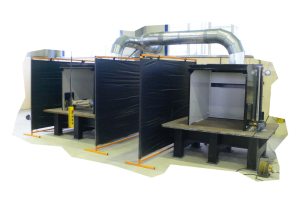
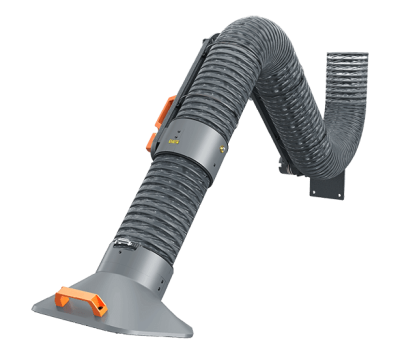
For indoor welding, businesses usually need to capture the fume close to the weld through suitable LEV. Options include on-torch extraction, movable arms, extracted benches, and enclosed booths.
The equipment must suit the work. A movable arm, for example, needs to remain close enough to capture the rising plume while allowing the welder to move comfortably. On-torch extraction can provide consistent source capture where the process and welding position allow it.
Suitable respiratory protective equipment may also be required where LEV leaves residual fume. Training, supervision, and routine visual checks help ensure that each control continues to work effectively during daily production.
Controlling metalworking-fluid mist in CNC machining
CNC machines and other machining equipment frequently use metalworking fluids for cooling and lubrication. Breathing its mist can contribute to occupational asthma, hypersensitivity pneumonitis, bronchitis, and irritation of the respiratory tract. Skin contact can also cause dermatitis.
A suitable approach may combine enclosed machinery with LEV that draws mist away from the enclosure. The system needs enough airflow to contain the contaminant while supporting the correct operation of the machine.
Businesses should also manage fluid quality, maintain sumps, check enclosure seals, and allow sufficient time for mist to clear before operators open machine doors. Where exposure creates a reasonable likelihood of asthma or dermatitis, suitable health surveillance may also be required.
Managing exhaust fumes and paint mist in automotive businesses
Running a vehicle inside a workshop releases exhaust gases and particles, including carbon monoxide. Car exhaust fumes can irritate the eyes and respiratory tract, while prolonged exposure to diesel emissions may increase the risk of lung cancer.
Tailpipe extraction captures exhaust fumes before they spread through the building. Depending on the workshop layout, this may involve fixed hoses, retractable reels, sliding rail systems or mobile units.
Bodyshops face a separate challenge. Spraying two-pack paints generates fine isocyanate mist capable of causing occupational asthma. The work should take place inside a suitable LEV-equipped booth or room, supported by appropriate air-fed breathing apparatus and an established clearance time.
Workers must understand how long the booth takes to clear and when entry becomes safe. Regular testing also confirms that the booth maintains the required airflow and containment.
Extracting wood dust in furniture production and joinery
Sawing, routing, and sanding timber or composite boards can release large quantities of fine dust.
Wood dust can cause asthma and dermatitis, while hardwood particulate matter is associated with nasal cancer.
Businesses usually control exposure by connecting effective extraction directly to woodworking machinery. The hood must sit close to the point where the tool creates dust, while the ductwork and filtration system must accommodate the volume and type of material generated.
Cleaning procedures are equally important because settled dust can return to the air when disturbed.
Reducing flour dust in food manufacturing
Flour dust presents a significant respiratory hazard in bakeries, mills, and food-production facilities. It is a recognised asthmagen, as are several enzyme additives used in commercial baking.
Exposure commonly occurs when workers empty bags, load mixers, or clean surfaces. Effective controls may include enclosed transfers, use of low-dust ingredients, careful handling techniques, and LEV around tipping stations and mixers.
The extraction system must capture dust while meeting the hygiene requirements of the production environment.
Controlling silica dust in construction and stone processing
Cutting, drilling and grinding concrete, mortar, brick, granite, and engineered stone can release respirable crystalline silica. These extremely fine particles can travel deep into the lungs and contribute to silicosis, chronic obstructive pulmonary disease, and cancer.
Fixed stone-processing facilities may use enclosed machinery, extraction benches, or purpose-designed hoods.
On construction sites, on-tool extraction allows dust to be captured directly from saws, drills, and grinders.
Water suppression can further reduce the amount of dust entering the air.
Keeping LEV systems effective over time
Every industry produces its own airborne risks, which means each system must reflect the relevant process, contaminant, and working environment. A welding arm, spray booth, and flour-dust extraction system all serve the same broad purpose, yet their design and operating requirements differ considerably.
LEV compliance therefore follows a complete cycle. It begins with understanding the contaminant and selecting the right control. Commissioning, training, maintenance, and regular testing then keep that control effective.
Explore the sectors we specialise in to see how Auto Extract Systems supports businesses facing a wide range of airborne hazards. Our specialists design, install, commission, maintain and test LEV systems based on each process, contaminant and working environment, helping protect employees and support ongoing COSHH compliance.

