








Every year, around 22,000 workers in the UK are affected by respiratory or lung problems caused or made worse by their work.
This situation cannot be treated as inevitable. Employers have a legal — as well as an ethical — duty to protect the workers for whom they are responsible. Where hazardous substances, including welding fume, are concerned, this obligation is governed by the Control of Substances Hazardous to Health Regulations 2002 (COSHH).
Controlling these contaminants requires technical expertise and solutions tailored to each process. Fortunately, a range of technologies is available, from respiratory protective equipment (RPE) to mobile local exhaust ventilation (LEV) systems.
Among these measures, capturing fume directly at source stands out for its efficiency. It intercepts contaminants before they reach the worker’s breathing zone or spread throughout the workplace.
Find out why this approach is essential for making welding operations safer.
Welding fume is a serious health risk
Welding fume is a complex mixture of extremely fine particles and gases. Its composition depends on factors such as the parent metal, surface coatings, filler material, and method.
Exposure to these elements can lead to short-term effects, including irritation and metal fume fever, as well as long-term diseases affecting the lungs and nervous system.
Crucially, the Health and Safety Executive (HSE) states that all welding emissions can cause lung cancer.
A common mistake among amateur welders is to assume that the absence of visible fume means the working environment is safe. This is not true. Hazardous particles and gases may remain in the air even after the plume has dispersed.
Capturing contaminants before they spread
General ventilation replaces or dilutes contaminated air. Although it remains useful for clearing residual fume, it allows the contaminant to enter the workplace atmosphere before attempting to reduce its concentration.
Source capture works differently. An LEV system creates airflow close to the welding arc, drawing the plume into a hood, extraction nozzle, or torch before it passes through the welder’s breathing zone.
This approach delivers two important benefits. First, it lowers the welder’s direct exposure. Second, it prevents fume from spreading to other employees, adjacent workstations, and surrounding surfaces. The HSE therefore describes source capture as the most effective way to reduce welding emissions.
Removing a concentrated plume also requires less air movement than attempting to clean an entire workshop after contaminants have dispersed. As a result, a properly designed source-capture system can offer more focused and energy-efficient control.
Choosing the right extraction method
There is no single extraction system suitable for every task. The correct solution depends on the process, workpiece, production layout, welding duration, and level of fume generated.
Common options include:
- On-torch extraction, which captures fume through the welding gun.
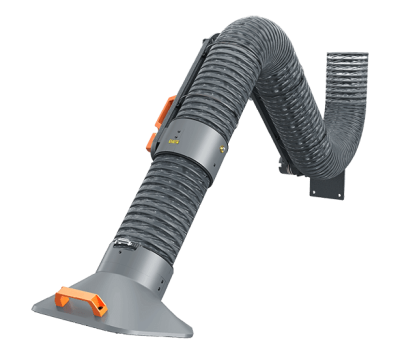
- Movable extraction arms, which offer flexibility for changing tasks and large
workpieces. - Extracted benches, which draw contaminants away from smaller components at
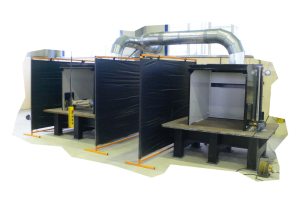
a fixed workstation. - Extracted booths or enclosures, which can help contain higher-volume or
automated processes. - Mobile LEV units, which provide source capture where permanent ductwork is impractical.
A COSHH assessment must determine which arrangement is appropriate. The evaluation should also consider substances within the fume, such as manganese, nickel, or hexavalent chromium, and whether additional controls are required.
Positioning determines performance
Installing LEV is not enough by itself. A movable hood that is too far from the arc, incorrectly positioned, or obstructed may capture very little fume. Cross-draughts can also pull the plume away from the extraction point.
The operator should position the hood close enough to collect the plume without disturbing shielding gas or restricting the work. It must then be repositioned as welding progresses. Workers therefore need practical training that shows what effective capture looks like and how to recognise poor performance.
Filters, ductwork, airflow indicators, and extraction arms also need to be inspected and maintained. Under COSHH, LEV systems must generally undergo a thorough examination and test at least every 14 months, although more frequent checks may be necessary.
Source capture is part of a wider control strategy
LEV works best as part of a complete exposure-control programme. Employers should first consider whether welding can be eliminated, reduced, or replaced by a lower-fume process. Metals must be properly cleaned, and access to welding areas controlled.
Where LEV cannot adequately capture all the fume, suitable respiratory protective equipment must be provided for the residual risk. RPE selection should be based on the hazard and task, supported by fit testing, training, inspection, and maintenance.
A safer workplace starts at the source
Once welding fume has entered the workplace air, controlling it becomes more difficult. Capturing it where it is generated protects the welder, reduces exposure among nearby workers, and prevents contamination from spreading.

