








Welding Fume and Grinding Dust: Structural Steel Case Study
The Client
The client on this project was one of the largest structural steel companies in the UK and Europe, specialising in the design, engineering, and production of structural steel products. The company has unrivalled capabilities and processes around 100,000 tonnes of fabricated steelwork per year.
The Challenge
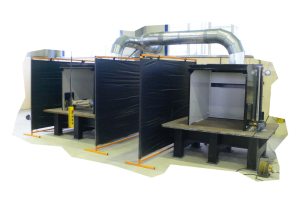
We were asked to design and install a comprehensive LEV (local exhaust ventilation) system in one of the workshops to safely capture and remove the welding fumes and grinding dust that were being emitted into the workplace’s environmental air during the structural steel business’s operations. The LEV system was installed as part of a project to ensure the site meets stringent operational requirements and to work strictly in accordance with HSE’s ‘HSG258: Controlling Airborne Contaminants at Work – A Guide to Local Exhaust Ventilation (LEV)’ guidance.
The structural steel company recognised that action needed to be taken to enhance the air quality in the workplace for its employees. However, given the nature of their products, they were unsure which method would be most effective in safely capturing and removing fumes and dust from the workplace, considering the scale of the structures they fabricate. Various methods of local exhaust ventilation had been trialled, though none had proven to be successful. The biggest challenge was to provide a solution that met their vast-scale requirements without disrupting their workshop’s production operation.
The Solution
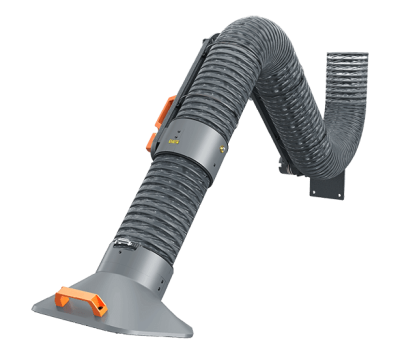
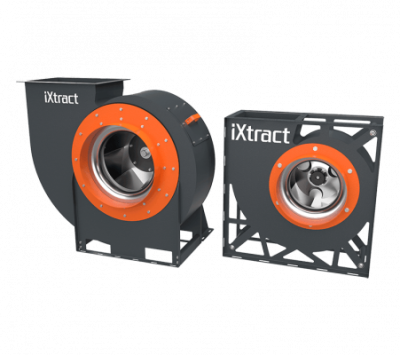
The solution was proposed and agreed to supply and install two new LEV systems to capture and safely remove welding fume and grinding dust at-source as part of a comprehensive LEV system. Both systems included the installation of new galvanised steel ducting and fittings. The first system was specified to accommodate eleven points, consisting of nine 11-meter and two 9-meter, whilst the second consisted of nine 11-meter ⌀160mm welding fume and grinding dust hose extraction arms. The points in each system ran to a dust extraction fan through a common duct via a reverse-pulse filtration unit, which has the capacity for six filter cartridges and provides the filter unit with a total filter surface area of 117 m² (19.5 m² per sleeve).
Additionally, the extraction arms were equipped with a 24-volt LED internal light for each feature. The lights are pre-fitted, energy-efficient lights located in the centre of the arm’s capture hood to help illuminate the workpieces while they are being worked on, and have a switch located on the arm’s external support bracket.
