










Welding Fume and Grinding Dust: Steel Stockholder Case Study
The Client
The client on this project was a steel stockholder with a 23,000 sq ft warehouse, which enables them to hold higher stock levels and respond quickly to customers’ requirements. At the site, the company engages in a small amount of fabrication, drilling, and grinding as part of its operational processes. Additionally, at the site, there were two gantry cranes operated in tandem, which had to be taken into consideration when proposing an effective LEV solution.
The Challenge
Auto Extract Systems was tasked with proposing and installing a comprehensive LEV (local exhaust ventilation) system in their new workshop to safely capture and remove the welding fumes and grinding dust before being emitted into the workplace’s air during the business’s operations. The LEV system was installed as part of a project to ensure the site meets stringent operational requirements to work in line with HSE’s ‘HSG258: Controlling Airborne Contaminants at Work – A Guide to Local Exhaust Ventilation (LEV)’ guidance.
In 2019, the WHO’s (World Health Organisation) International Agency for Research on Cancer reclassified welding fume as a carcinogen after new scientific evidence came to light. The research found that exposure to mild steel welding fumes can cause lung cancer, possibly kidney cancer and neurological effects similar to Parkinson’s disease in humans. As a result, the Workplace Health Expert Committee (WHEC) endorsed the reclassification. It updated their enforcement expectations for mild steel welding fumes, stating: “Regardless of duration, HSE will no longer accept any welding undertaken without any suitable exposure control measures in place, as there is no known level of safe exposure.”
The enforcement expectations came into force with immediate effect, primarily because general ventilation does not provide the necessary control required to safely protect workers. In the STSU1 – 2019 Safety Alert Bulletin: Change in Enforcement Expectations for Mild Steel Welding Fume, businesses were advised to: “Make sure exposure to any welding fume released is adequately controlled using engineering controls (typically LEV).”
The Solution
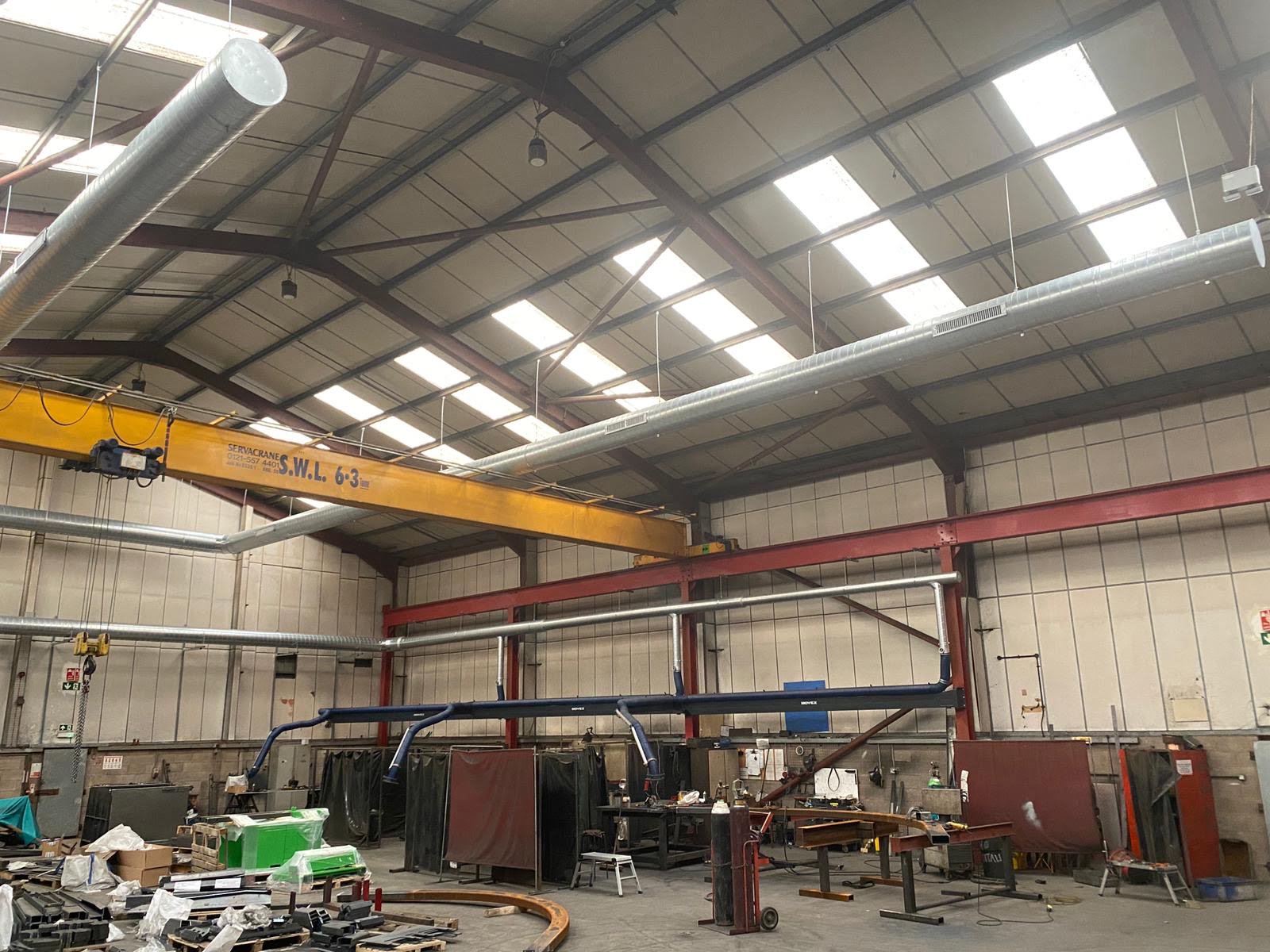
The solution was proposed and agreed to supply and install two LEV systems, the first to capture welding fumes and grinding dust at-source, whilst the second was to capture residual welding fumes and gases as part of a ‘wrap-around’ general ventilation system.
Hose Extraction System
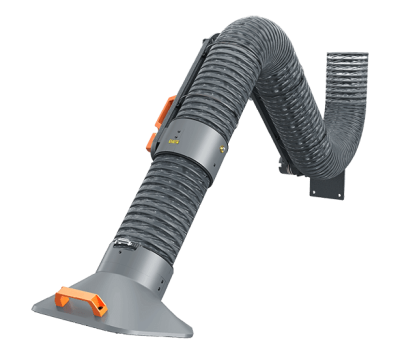
The first system included installing new galvanised steel ducting and fittings to accommodate seven points, which consisted of five 11-meter, a nine-meter and a 7-meter long, ⌀160mm hose extraction arms. As the system was used for both welding and grinding processes, to adhere to HSG258 guidance, welding fumes, dust, and gases were fed through a common duct to a filtration unit via a centrifugal fan.
The hose extraction arms specified featured metallic fume capture hoods, gas-powered support struts and four-way knuckle joints. The arm’s design means they are fully flexible and can be turned virtually 360° to be operated above and below their mounting height, which allows the user to position the hood at-source with a simple operation. This extraction arm also provides the workshop with 25% increased airflow over a traditional-styled internal knuckle extraction arm, as it features externally mounted supports, which reduce static pressure air drops. An ergonomically designed hood that is ideal for collecting hot welding fumes, gases, and grinding dust. The capture hood features a flat base to take benefit from the Coanda effect; the phenomenon is known to ccience when a jet of air clings to a flat surface over a longer length than it would over towards an open collection area, enabling a greater collection of fumes over a longer length than any traditional type all round hood.
The filtration unit specified for this LEV system was a modular dust bank collector filter that could accommodate four cartridge filters. The filtration unit features the latest innovative technology and is capable of self-monitoring, self-cleaning, and filtering with up to 99.9% efficiency. A high level of filtration is achieved in this filter by a reverse-pulse process, whereby compressed air is manually released down the inner side of the filter cartridge over the internal ‘torpedo’ shaped filter carrier. This process allows for the pneumatic air to be used more effectively down the full length of the filter (compared to conventional cage carried or shaker type filters). It also prolongs the life of the filters and reduces maintenance costs by replacing them more frequently. Dust collects in a metal waste bin below and has a 95-litre capacity.
The LEV system was also specified to accommodate another point, as stated during the free site assessment (book yours here), that the business had plans to grow the fabrication workshop. As a result, a comprehensive fan and filtration system capable of managing both the additional airflows and filtration required at the addition point was installed, thereby saving the company money in the future by avoiding the need to change the fan or filter.
Wrap-Around System
The second LEV system was a ‘wrap-around’ system, which works by capturing and expelling any residual plumes (comprising dirty, hot fumes, gases, and dust) that have risen into the roof space. As the fume leaves the workpiece, it quickly rises to a high level and will eventually meet the cooler roof fabric, which it cannot pass through. The fume will then cool and begin to return downwards, settle, but as it still has buoyancy, it can be seen to hang in the roof space (2 to 3 metres from the roof), typically around crane track height. The ‘wrap-around’ system was carefully positioned in the space above the bays and will continually capture and remove fume. The system featured dampenable grilles along a dual-ducting run located above the gantry crane track.
Fans
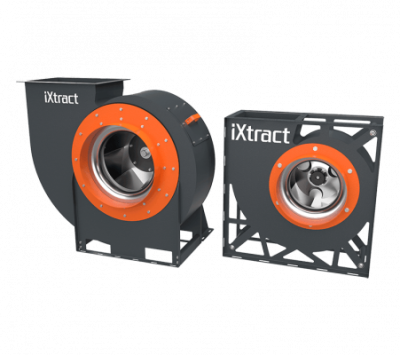
All fans specified for the two LEV systems exceed the E.U. Directive 2009/125/EC ErP, which aims to reduce CO² emissions by 20% by using energy-efficient motors in conjunction with industry-leading blade design.
The LEV system’s fan outlet was ducted to the atmosphere via the nearest wall, where it was vented upwards to the atmosphere through high-velocity cowls, as per HSE guidance. The LEV systems were designed to be fully compliant with the latest HSE guidance and to achieve 100% utilisation, allowing all points to be open simultaneously.
